Privacy Policy
Cookie Policy
Legal Notice
VERONICA POLLINI - Italy
CONTACTS: veronica.pollini@gmail.com
Website www.mosaicoarredo.com
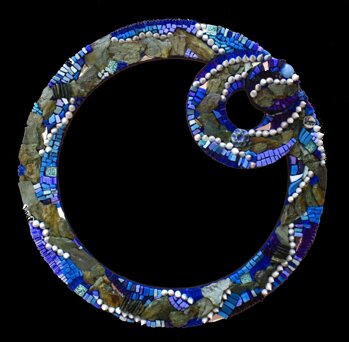
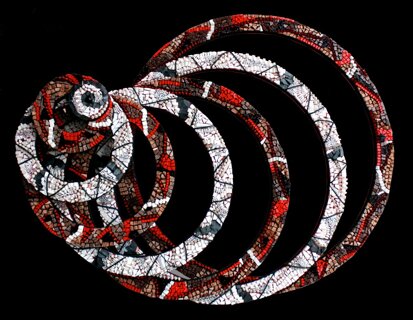
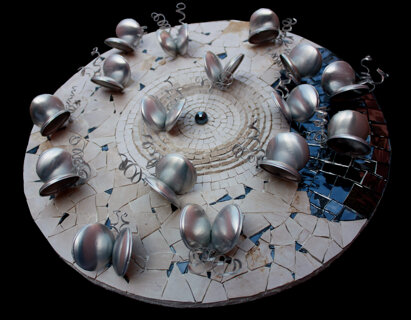
Octave - mosaic on wooden support
The Other Moon - lunar dream (love knot)
Venetian enamels, Spectrum glass, marble, granite, slate, pebbles, self-made ceramic tiles
Venetian enamels, mirror, art glass, stones, handmade ceramic tiles diameter 40 cm
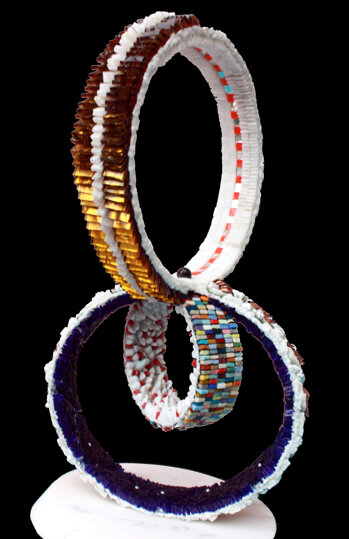
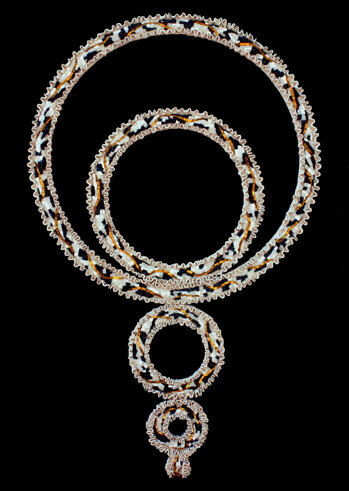
Swan Lake - mosaic on wooden support
Souls - sculpture - mosaic on wooden support
160 self-made ceramic tiles, alabaster, marble, Venetian enamels, mirror glass. 120 x 75
Carrara marble, onyx, Venetian enamels, glass marbles, self-made ceramic tiles, glass 32 x 56
The planet of butterflies - mosaic on wood
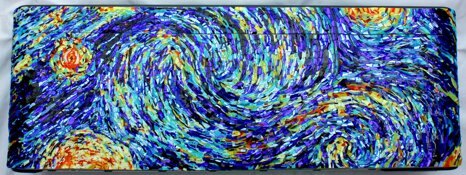
Starry night - mosaic on wooden support
Travertine, mirrored glass, black glass marble, aluminum diameter 45 cm
art glass - courtesy of Daikin Italy
Her Biography
Veronica Pollini (VeroMosaico)
With a degree in Marketing and Communication from IULM University in Milan, and a Master’s thesis on the organization of cultural events, in 2010 she attended a mosaic course at S.I.S.A.M. (International School for Studies in the Art of Mosaic and Fresco) in Ravenna.
Since then she has been creating mosaics, also on home décor pieces, favoring the direct technique on the final support.
Her research aims to highlight the communicative power of the circle-form while, at the same time, experimenting with unusual combinations of materials of different kinds: glass, enamels, ceramics (also self-produced), marbles, etc.
The Critique
Critical text by Chiara Salanti
Throughout its long history, mosaic technique has mainly served a decorative function, which has determined a close link—on a not only technical-executive but also iconographic level—with its field of application.
Widely used in Roman and Byzantine civilization and throughout the Middle Ages, mosaic took on, from time to time, celebratory functions in places of power, didactic and devotional aims in sacred buildings, and ornamental features in private homes, adapting to the occasion in a figurative or geometric-ornamental language. In such applications, decorative dimension and expressive vocation merged, allowing the flair of artists—bound to themes and subjects prescribed by patrons—to emerge in technical skill, chromatic sensitivity, and the visual translation of the culture and thought of their time. A continuous shift in this decoration-expression relationship would mark the entire history of mosaic art until, between the late 19th and early 20th centuries, major Modernist interpreters such as Gaudí and Klimt would redeem its merely decorative role by placing it at the center of their research, respectively architectural and pictorial.
Within these horizons, tied to the historical evolution of mosaic, moves the research of Veronica Pollini, aka VeroMosaico, trained at the International School for Studies in the Art of Mosaic and Fresco in Ravenna.
Always fascinated by the chromatic and luminous potential offered by combining different materials—art glass, gold leaf, mirrors, stones—Veronica began her production by devoting herself to furnishings and objects. The experience gained in decoration, understood as giving the object its own identity—an identity that reveals the object’s hidden soul yet changes depending on the viewer’s standpoint—guided Veronica toward art in the proper sense, offering her the chance to deepen her expressive research in works able to address themes linked to personal experience. Thus were born the first marine figures, charged with the vitality and irony of a Milanese artist who became an “inhabitant of the sea,” later culminating in Jellyfish in 2016, presented at the exhibition Pictor imaginarius in Nazzano (Rome). From the same year dates The Planet of Butterflies, a transitional work between the first figurative production,
focused on naturalistic themes, and the current research that has identified the circle as a form with which to represent both abstract concepts and human and animal figures. In Souls circles of different sizes, with multiform and multicolored surfaces, overlap and intersect to indicate the complexity of the soul and at the same time suggest a collision of souls, taking shape as a three-dimensional art form that dialogues in space. In No War opposition to war takes concrete form in the series of noisy dark circles of a tank whose gun barrel bursts into a colorful flower, while in Cancer Healing the yearning for life becomes double in the breast that evokes motherhood, and thus life, and in the circle that represents it, itself a symbol of the circularity of existence. If Souls crosses into the realm of sculpture, No War and Carcer Healing by virtue of their frontal reading can be conceived as paintings. In each of these cases, mosaic becomes one with the support, rising to an art form in a broad and transversal sense, as had already happened in the earlier Mosaitril of 2016, an ironic mosaic ready-made, Veronica’s personal tribute to Pop Art.
What unites the most recent works, beyond freeing them from purely decorative needs, is the use of the circular form, chosen by the artist for its symbolic value. A figure made of a single line whose ends join into one another, the circle is therefore an emblem of what has no end or beginning and consequently of eternity. Likewise, because it lacks opposing parts such as top and bottom, it represents perfection and harmony. These meanings, already known to ancient civilizations, gave rise to so-called magic circles, rituals used in ceremonial magic, practiced especially between the Middle Ages and the Renaissance, in which a
circle was traced on the ground as a form of protection, to keep out negative and evil energies. Reconnecting to the archetypal role of the circle, Veronica coins a true artistic category, which she likes to define as “circular mosaics,” where the form itself rises—through the values it carries—to an expressive tool, taking shape in a module reproducible in potentially infinite numbers and sizes. The form then finds completion in the material on which, in recent times, Veronica intervenes personally by producing some ceramic tesserae, through modeling and coloring the material. This intervention, driven by Veronica’s desire to leave an even more marked sign of artistic research in her works, represents the further stage of a maturation process that has been able to combine decoration and expression, arriving at the affirmation of matter and form themselves as the artist’s poetic manifestation.
CV
Exhibitions and competitions
2019 Group Exhibition "Musiwa Week 2019" – Palazzo Medici Riccardi, Florence (FI)
2018 Competition and group exhibition “Pictor Imagnarius” – Museo del Fiume, Nazzano (Rome)
2018 "Vernice Art Fair" - Passepartout Art Galery - Forlì (FC)
2018 Group Exhibition "Musiwa 18" – Palazzo Medici Riccardi, Florence (FI)
2017 Group exhibition "Torano night and day", Carrara (MS)
2017 Participation in the creation of the collective ceramic mosaic on biodiversity, Nazzano (Rome)
2017 Competition and group exhibition “Pictor Imagnarius” – Museo del Fiume, Nazzano (Rome)
2017 Group Exhibition "Musiwa 17" – Palazzo Medici Riccardi, Florence (FI)
2017 Group exhibition "Pop Art Tribute" – Icona Art Room, La Spezia (SP)
2016 Competition and group exhibition “Pictor Imagnarius” – Museo del Fiume, Nazzano (Rome)
2016 Group exhibition “You Can’t Do Dripping” – Spazio Monte Amiata, Milan (MI)
2016 Solo exhibition at “Locanda Ameglia Alta” – Ameglia (SP)
2015 Solo exhibition “To Tessellate or Not to Be” at “La Fabbrica” Santo Stefano Magra (SP)
2015 Live painting session at the event “Art in the Village” – Corrodano (SP)
2015 “Reduced group exhibition” – Sarzana (SP)
2015 “Carrara days of art” – Marina di Carrara (MS)
Privacy Policy
Cookie Policy
Legal Notice