Privacy Policy
Cookie Policy
Legal Notice
PAOLA ZANNONI - Italy
CONTACT: galleriazannoni@virgilio.it
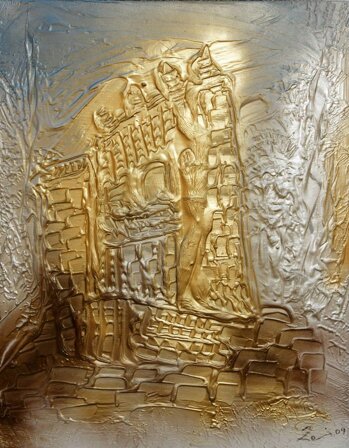
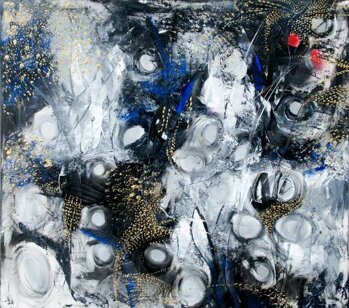
Untitled
Middle Ages
palette knife oil on canvas cm 100 x 100
gesso and acrylic on canvas
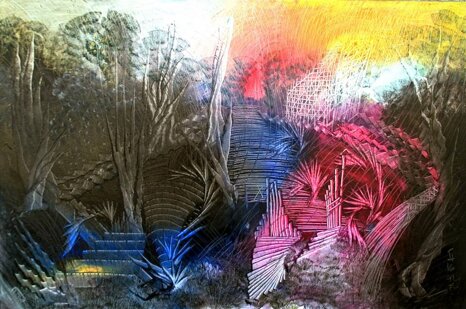
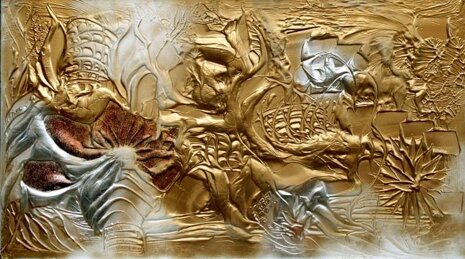
Gold
The lady
gesso and acrylic on panel cm 150 x 100
palette knife oil on canvas 100 x 150
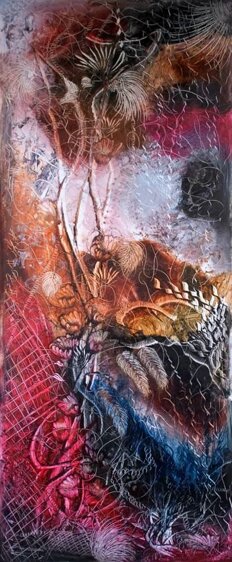
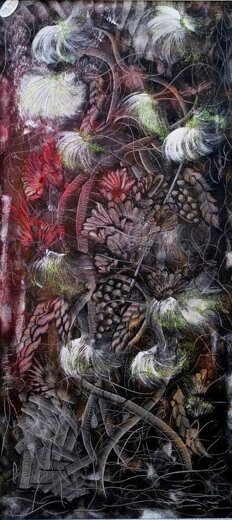
Energy
Untitled
palette knife oil on canvas cm 80 x 160
palette knife oil on panel cm 110 x 220
Her Biography
Paola Zannoni was born in Campiglia Marittima, a small medieval village. And from the age of twenty she lived in this small yet picturesque and evocative setting, studying and developing those shapes and colours that would later appear in a surprising and most unusual pictorial expression that has earned—and continues to earn—many, many admirers in Tuscany and elsewhere; acclaim accompanied and confirmed by countless cups, medals and various awards.
Paola’s painting is highly expressive in its subjective appraisal of colours and forms. It is precisely the images—spontaneously distorted—that seek to portray the many inner transformations of modern man, at times anguished and frustrated by existential problems, at times uplifted and calmed by idyllic visions.
This very interesting and personal painting intrigues and captivates; it will amaze and unsettle both layman and connoisseur… why?
Because it generally does not arise from the reproduction of real, concrete subjects, but from visions and impressions that only she experiences, perhaps even unbeknown to her own “self”.
What surprises in Zannoni’s paintings is not only the forcefulness of the image—at times monstrous and demonic—that is depicted and that reveals great strength of character; it is also the mastery with which she arranges the combination and contrast of colours. At times they are numerous and well blended; at times there is only one colour, yet the shades she creates are such a pleasure to behold the conveyed image, to receive the message of joy or sadness, of discouragement or satisfaction that colour sends us like a familiar piece of music. As if the transposition onto canvas of the depth and frankness of human content that only this painter can render in such an original way were not enough, she also creates beautiful floral motifs on canvas and linen for making scarves and foulards, lampshades and drapes, tablecloths and garments.
The Review
Paola Zannoni’s Works: between Nourishment and Art. Between Matter and the Invisible. Art is the food of the soul. That is a fact. Just as the food we eat every day gives us substance and nourishment, so art feeds our imagination, quenches our creative dryness, sets our mind in motion, letting us travel while standing still. In short: it moves us when we allow it to resonate with us. The sight of a painting and the three-dimensionality of a sculpture speak to us, triggering an invisible yet perceptible vibration. Through the channel of individual subjectivity, art travels through the senses and creates true synaesthesias. To the point of translating these vibrations into emotions that can become suggestions and turn into smell, taste and touch. Paola Zannoni’s art manages to express a very strong, conflicting dualism: that between Matter (conventional reality) and the Invisible (reality as each person perceives it through their own unique feeling). The material component of her colours, which come out of the canvas and begin to travel, to form tangles, clots that can be touched, clothes Paola’s feelings not only with forms, but with substance. Because it nourishes her dreams and desires, thus wiping out all the fears that prevent her from quenching her thirst for serenity. These are feelings that urgently need to declare themselves to themselves and to the whole world. Immediately. In the hours of day as of night. This is the call of art. Her works are the fruit of the crystallisation of memories and unspoken words. They remain there, unchanged, after travelling through the labyrinths of the soul. Anomalous labyrinths where man already finds himself at the centre. And seeks the way outwards. Towards a light that is not always easy to reach. A goal often pursued while stumbling, getting hurt, then getting back up, aware of having to stop to rest. And then setting off again to chase that light which now leads us to create the surrounding reality and give it a name. A name that is not other people’s and does not have other people’s taste. It is the name we give it and it has the taste we want. And for this reason it bears the name of the world. Of our World. Of which we are all citizens, unfortunately not always free and not always equal. Citizens who are not necessarily meant to like the same food. But citizens capable of marvelling at everyday things as if it were the first time. Of biting into an apple and tasting not only the fruit, but the story of humankind. A bit like looking within to seek a light, a crack, an anchor, an Ariadne’s thread to find the way and never lose it again.
Dr. Alberto Benedetti
Perhaps starting from the vision of a composite and luxuriant nature, from the essence of spontaneous exuberance, uncontaminated by the hand of man, from which the constructions of thought have moved, in a positive and negative sense; the painter projects onto the canvases her messages of spiritual and social protest, seeking a harmony – partly achieved – between poetic needs and the compromised manifestos of survival, which appear particularly dark because they are clouded by the ever-present spectre of war, which today has taken on the prophetic features of “Solvet saeclum in favilla”.
In Paola Zannoni’s paintings the questions of the subconscious take shape, pouring into the conscious out of an explanatory need, and her creations are like a motive of moral justification, for the acceptance of time, immersed in the embattled dimension of the struggle for survival.
In describing reality – while remaining above it – the Artist seems to want to tell us: “I dreamed of a better world and, not finding it, I return to the evocative motives of the primary dream, not out of fear but in order to contemplate – within the limits of what is possible – the fundamental truths, supporting columns of the spirit”.
This is the spiritual “Iter” of a large part of artists, adult children in the best sense of the word, dreamers fully aware of the origin of the dream.
Accurate painting and, I would dare say, with “romantic” accents in the sentimental value of the word, in the assumption of a “secular mysticism” that almost always runs parallel to the poetics of the love granted to us.
Well-controlled figurations, even within the declamatory nature of fantasy, brushwork control that comes from other observed disciplines, from technical studies, which serve excellently – in any case – as reins to guide the fiery steed of pure feeling.
Giorgio Tuti
Art Gallery “Il Machiavello”, Florence
On the canvas, the palette knife and the brush, moved by the magnificent motion released from the artist’s subconscious, create forms and colours that are pleasing to the eye. The attentive observer tries to glimpse an answer to the intricate skein of lines and colours harmoniously interwoven.
Mario Baldassarri, Il Telegrafo, Livorno
The world of artistic projection of our Painter often appears to us as immersed in an underwater, silent atmosphere, where sounds do not reach, since it is the brushstroke that narrates – in an apparently informal, abstract synthesis – the story of an experience, of thoughts seeking a harmonious solution to the succession of images, of joyful and painful teachings.
This atmosphere of gentle detachment from the turmoil and mutability of feelings is, however, transcribed – in an immediate reconsideration – onto the habits of a hypothetical mountain, where every experience is set aside in the recording of essential traits, beyond that passion of human things which not infrequently drags into the whirlpools of the irrational.
Escape, then, in the accurate painting rich in musical counterpoints of the Artist, and a tendency towards descriptive detachment: passion reappears, however, here and there in Paola Zannoni’s floral compositions, and on the occasion the words of a French writer, famous particularly for his “Maximes”, come back to mind:
“Les passions sont les seuls orateurs qui persuadent toujours. Elles sont comme un art de la nature dont les règles sont infallibles; et l’homme le plus simple qui a de la passion persuade mieux que le plus éloquent qui n’en a point.”
Fire under the ashes, in essence, in the painter’s balanced and pondered surrealism, a touch fully in tune with the intended ideal aims: useless embellishments empty of meaning are not to be found, and the continuity of inspiration is appreciated, without false ideologies that – often – make one doubt the artist’s vocation.
Also highly appreciable is the decorative tone of the paintings: beyond any ambitious polemic, the spontaneity of projection remains, with the means chosen after a not insignificant representational journey.
Pierre La Roche
The judgement on the Artist’s work can only be positive and confirms the correctness of the choice. She has taken part in solo and group exhibitions held in our Municipality and in nearby centres, as well as other important national events. She is present in the social life of the Municipality by joining initiatives promoted by the Municipality itself and by cultural associations; she is a person esteemed and respected by our entire Community.
(Judgement expressed by the Mayor of Campiglia Marittima, Lorenzo Banti, on the occasion of the awarding to Paola Zannoni, by the Accademia dei Maestri, of the Grand Trophy “A Life for Art” 1988, with appointment as a Member of the Academy as an Academic Master. The award of the recognition, at the Rossini Hall of the Excelsior Gallia in Milan, takes place on proposal of the Academy’s Management which, precisely, requires as a “conditio sine qua non” the opinion of the Mayor of the Artist’s city of residence.)
From the ARTE RIMECO catalogue, Switzerland:
ZANNONI Paola, was born in Campiglia Marittima in 1954 and lives in Venturina (Livorno). She attended a technical course of study up to the age of 18, obtaining a diploma as a stenotypist. She was already prepared to enter the world of work when she realised that the activity best suited to her was art, and she immersed herself in it with all her passion.
Always present in the art world, she reaps excellent recognition.
Critical reviews: …Paola Zannoni grafts her painting onto pure abstraction at times; at others she pours the play of forms into a screaming passion of the absent subject, stirring with dark and ambiguous fetishes. (Carlo Franza); … In Paola Zannoni’s paintings the questions of the subconscious take shape, pouring into the conscious out of an explanatory need and her creations are like a motive of moral justification for the acceptance of time, immersed in the embattled dimension of the struggle for survival. (Giorgio Tuti); … The world of artistic projection of our Painter often appears to us as immersed in an underwater, silent atmosphere, where sounds do not reach, since it is the brushstroke that narrates – in an apparently informal, abstract synthesis – the story of an experience, of thoughts seeking a harmonious solution to the succession of images, of joyful and painful teachings. (Pierre La Roche).
Privacy Policy
Cookie Policy
Legal Notice