Privacy Policy
Cookie Policy
Legal Notice
SVETLANA ELANTSEVA - England / Russia -
CONTACTS: www.elantseva.co.uk www.artinternationalgallery.co.uk
phone + 44 7851 759 761 www.artinternationalgallery.co.uk
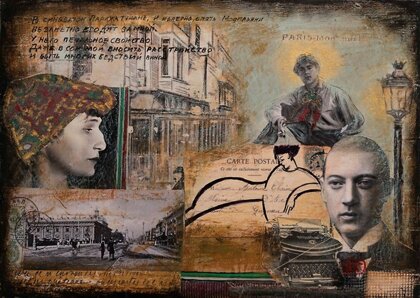
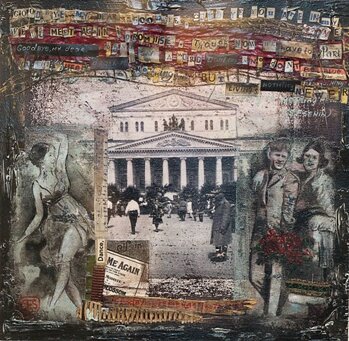
My sad Angel. Anna and Amedeo. 2017
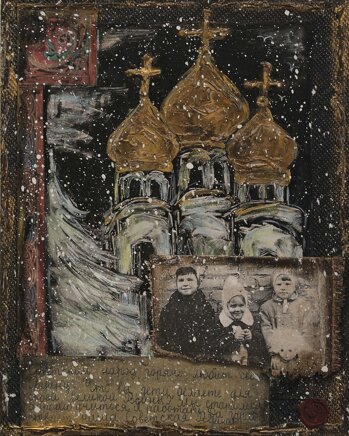
Memory of my childhood, 2017
Mixed Media on Wood
Mixed Media on Wood
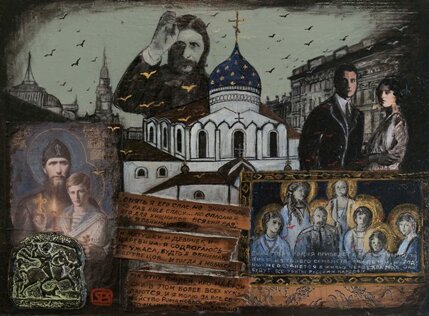
Mystery of Grigory Rasputin's death: myths and ind
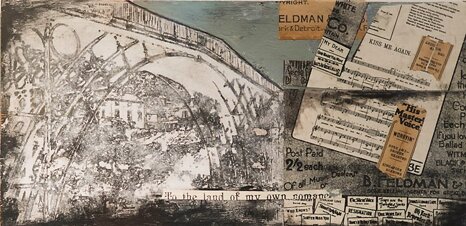
First Iron Bridge in Europe, Shropshire,
Mixed Media on Wood, 42 - 55 cm
Mixed Media on Wood, 44 cm - 34 cm, 2014
4. Rowley's House in Shrewsbury,
Tragic Dance of Life
Mixed Media on Wood, 44 - 34 cm, 2014
Mixed Media on Wood, 50 x 30 cm
THE MEANING OF HER ARTWORKS
1. Svetlana Elantseva Southorn
Memory of my childhood, 2017
Mixed media on wood
For Christmas when I was 6, I asked for a doll. In the weeks before Christmas, the biggest present I’d ever seen to date was wrapped in the corner of the living room; it was even too large to fit under the tree. I hoped beyond hope that I knew what it was. On Christmas Day, I opened it: there stood a beautiful tall doll made in Germany, named Lika. Oh my God! I almost fainted with happiness. My parents probably used all the money they could for it because we didn’t have many toys in shops at that time (Soviet time). In 2001 I visited my mother and decided to take my doll to the U.K., just as a memory of my childhood, and I found out that my mother had thrown the doll out. It was a shock for me. I felt as if I had lost my best friend. Several months ago I decided to make this picture—just as a memory of Lika and my childhood.
2. My Sad Angel. Anna and Amedeo. 2017
Mixed Media on Wood
artist: Svetlana Elantseva
'Paris is in dark mist
And probably again Modigliani
Imperceptibly follows me.
He has a sad virtue
To bring disorder even to my dreams
And be the reason of my many misfortunes.'
(Anna Akhmatova)
In 1910 the Russian poet Nikolai Gumilev brought his young wife, also a poet, Anna Akhmatova, to Paris. The couple came on their honeymoon.
At six feet tall, raven-haired and ravishingly beautiful, 21-year-old Anna Akhmatova caused something of a sensation when she arrived in Paris—people would turn to look at her in the street.
Being poets of some repute in their native Russia, they headed straight for Montparnasse, then the favoured haunt of the Parisian avant-garde. Here they mingled with penniless painters, sculptors, poets and composers.
One such artist was the 25-year-old Italian Jew Amedeo Modigliani. With an aristocratic Roman nose, a strong jaw and a mop of jet-black hair, he enchanted Anna, and the two became inseparable.
“We both did not understand one very important thing—everything that happened was for both of us a pre-history of our lives—his, very short, and mine, very long.” (Akhmatova)
In 1911 Akhmatova came back to Paris by herself. She stayed for several months this time and wrote a poem about their love, Heart to Heart Is Never Chained. The final stanza reads, “Why, oh why, should I find you/Better than the one I chose?”
On one occasion she visited Modigliani, but found him absent. “We had apparently misunderstood one another so I decided to wait several minutes,” she said. “I was clutching an armful of red roses. A window above the locked gates of the studio was open. Having nothing better to do, I began to toss the flowers in through the window. Then without waiting any longer, I left. When we met again, he was perplexed at how I had entered the locked room because he had the key. I explained what had happened. 'But that’s impossible—they were lying there so beautifully.’”
Modigliani died on 22 January 1920 of tubercular meningitis in a hospital for the homeless, aged 35.
In November 1965, shortly after being allowed to travel to England to receive an honorary doctoral degree from Oxford University, Akhmatova suffered a heart attack and died at the age of 76.
3."Mystery of Grigory Rasputin's death: myths and indisputable facts." Mixed Media on Wood, 42 - 55 cm, 2017
Sometimes critical turning points in history are overlooked; pivotal moments are ignored or simply forgotten. But every now and then a web of deceit is deliberately woven around an event, leaving its true significance concealed so that future generations remember it only as a piece of insignificant trivia, or maybe an item of lurid scandal, rather than a momentous historical episode.
One such example is the life and, more particularly, the death of Grigory Rasputin.
His name has almost become a byword for mystery and debauchery, but Rasputin’s role in the events leading up to the Russian Revolution remains essentially obscured. In effect, a legend has grown up around the man, but the reality may be far more intriguing than the popular myth.
For Rasputin’s murder (Prince Yusupov) may have set the stage for some of the most significant events of the 20th century and ultimately resulted, indirectly, in the deaths of many millions more.
Despite claims that British intelligence wanted to get rid of Rasputin because he was urging that Russia make peace with Germany, his murder was probably part of a longer-term and altogether more sinister agenda.
Prince Yusupov was probably first spotted a few years previously while he was at Oxford University, which, like Cambridge, had become a fertile recruiting ground for British Intelligence. Not only was Prince Yusupov the second richest man in Russia, after the Tsar, he was also close to Russia’s imperial family and, as such, would have been viewed as a potential asset to be groomed for later use.
On the night of December 29, 1916, a group of conspirators, including the czar's first cousin, Grand Duke Dmitri Pavlovich, and Prince Felix Yusupov, invited Rasputin to Yusupov's palace and fed him wine and cakes laced with cyanide. Though Rasputin eventually became rather drunk, the poison seemed to have no effect. Baffled but not deterred, the conspirators finally shot Rasputin multiple times. He was then wrapped in a carpet and thrown into the Neva River, where it was discovered three days later.
There were two officers of the British Secret Intelligence Service (SIS) in Petrograd at the time. Oswald Rayner knew Yusupov since they had met at the University of Oxford. The second SIS officer in Petrograd at the time was Captain Stephen Alley, born in a Yusupov Palace near Moscow in 1876, where his father was one of the prince's tutors.
On Rayner's return to England, he not only confided to his cousin, Rose Jones, that he had been present at Rasputin's murder but also showed family members a bullet which he claimed to have acquired at the murder scene. "Additionally, Oswald Rayner translated Yusupov’s first book on the murder of the peasant, sparking an interesting possibility that the pair may have shaped the story to suit their own ends."
Living out the role of the “man who killed Rasputin”, Yusupov was to tell numerous stories about the event. Often contradictory, they served to throw a veil of disinformation and deceit over the actual killing. For although the ageing homosexual and transvestite implied that Rasputin was secretly in love with him, which is probably yet more disinformation, never once did he even hint at the involvement of the British Secret Intelligence Service in Rasputin’s murder. Like the good intelligence asset he was, that secret went with Prince Yusupov to the grave.
Epilogue
Shortly before Rasputin's death, he wrote to Nicholas to predict that if he were killed by government officials, the entire imperial family would be killed by the Russian people. His prophecy came true 15 months later, when the czar, his wife and all of their children were murdered by assassins amidst the Russian Revolution.
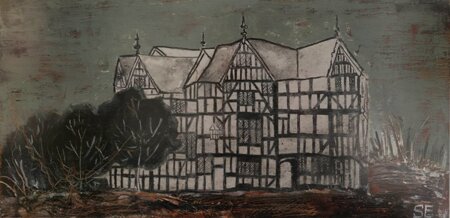
4. Rowley's House in Shrewsbury,
Mixed Media on Wood, 44 - 34 cm, 2014
Rowley’s House in Shrewsbury is one of the town’s best-known timber-framed buildings. The complex actually comprises two adjoining buildings, one of which is timber-framed (originally built as a merchant's warehouse in the 16th or early 17th century) and the other a stone and brick building built around 1618 (the mansion of the merchant William Rowley). Rowley’s Mansion is also the earliest surviving example in the town of the use of brick to build a house. The buildings
are among the finest in Shrewsbury
5. Svetlana Elantseva Southorn
First Iron Bridge in Europe, Shropshire,
Mixed Media on Wood, 44 cm - 34 cm, 2014
The Iron Bridge is a bridge that crosses the River Severn in Shropshire, England. Opened in 1781, it was the first arch bridge in the world to be made of cast iron, and was greatly celebrated after construction owing to its use of the new material.
The first metal bridge in Europe, "The Iron Bridge in the county of Shropshire",
mixed media on wood, 44 - 34 cm, 2014
In 1778, Abraham Darby III built in Shropshire the famous Iron Bridge from cast-iron components—the first bridge in Europe made entirely of metal structures. The bridge connects the banks of the River Severn and is listed as a UNESCO World Heritage Site.
6. Tragic Dance of Life
Mixed Media on Wood 50 - 30 cm, 2016
When the Russian poet Sergei Yesenin first met Isadora Duncan, he knew immediately that he had to do something—something really striking and expressive. He swore loudly, said, 'Everyone, out of the way!' and performed a wild, foolish but passionate dance for Isadora. Then he fell to his knees. Isadora stroked his head and said, 'Angel'. She looked into his eyes and said, 'Devil!' And so they declared their love.
Tragic dance of life
Isadora Duncan knew, at most, a couple of dozen words in Russian; surprisingly, that tiny vocabulary was more than enough for her, when she met the young Russian poet, to exclaim in admiration: “Angel.” And, looking into his eyes, to whisper: “Devil.”
LA SUA BIOGRAFIA
Alcune delle mie opere d’arte traggono ispirazione dalla mia vita in Russia. I processi esplorano diversi modi di lavorare e di integrare tecniche osservate, fotografate e documentate durante la mia vita a Mosca, nel Sud della Russia e nella regione degli Urali. La mia traduzione di idee, design e immagini viene utilizzata per dipinti, collage, sculture in ceramica 3D, fotografie e film. I colori usati per le sculture e alcuni dipinti evocano l’atmosfera della Russia.
Sono nata in Russia. Ho lavorato come membro di un team di artisti che produceva arte in stile sovietico comunista fino all’evento della Perestrojka.
In Inghilterra ho completato un BTEC in Fine Art, un Foundation Degree in Creative Art for Employment presso la Staffordshire University, seguito da un BA HONS in Entrepreneurship for the Creative and Cultural Industries (Fine Art) presso la Staffordshire University.
Cerco di espandere la mia arte a livello locale e internazionale, usando l’eredità e l’influenza culturale come veicolo per l’espressionismo, creando legami tra culture attraverso il mezzo dell’arte.
I miei dipinti e le mie figure in ceramica sono immediatamente riconoscibili come di stile russo, grazie ai colori e al modo in cui vengono usati insieme. Nel corso della mia vita e dei miei viaggi sento sempre un legame con la mia terra d’origine. Questo sviluppa il mio percorso, la mia arte, in cui rendo omaggio alla mia eredità, al mio paese e ai suoi modi di vivere.
Formalmente ho già creato collegamenti tra la mia comunità artistica locale, artisti del Regno Unito e artisti professionisti russi formando l’Art International Group, organizzando mostre per esprimere diversità e comprensione.
Nel processo del mio nuovo progetto ho esplorato mezzi e metodi di interazione per esporre opere d’arte sia tecnologicamente sia in modo tradizionale, usando l’eredità come collegamento fondamentale per i mezzi di espressione.
L’impegno di mantenere la cultura attraverso l’arte nel contesto del patrimonio è qualcosa per cui provo una profonda affinità, abbracciando il mio background culturale nelle mie opere attraverso la reazione sentita alla mia diaspora dalla mia terra natale.
Espongo le mie immagini in tutto il mondo. Le mie opere sono in collezioni private nel Regno Unito, Russia, Turchia, Bulgaria, USA, Cina, Germania, Grecia, Canada, Sud Africa, Bielorussia, Ucraina, Austria, Slovenia, Serbia e Corea del Sud.
Sono membro della International Federation of Artists, della Russian Society of Professional Artists, membro del SOLO Group, della Visual Art Network Society, della Shropshire Art Society e lavoro come direttrice dell’Art International Group.
Privacy Policy
Cookie Policy
Legal Notice